
Governor Newsom and the Legislature’s unprecedented investments are making a difference
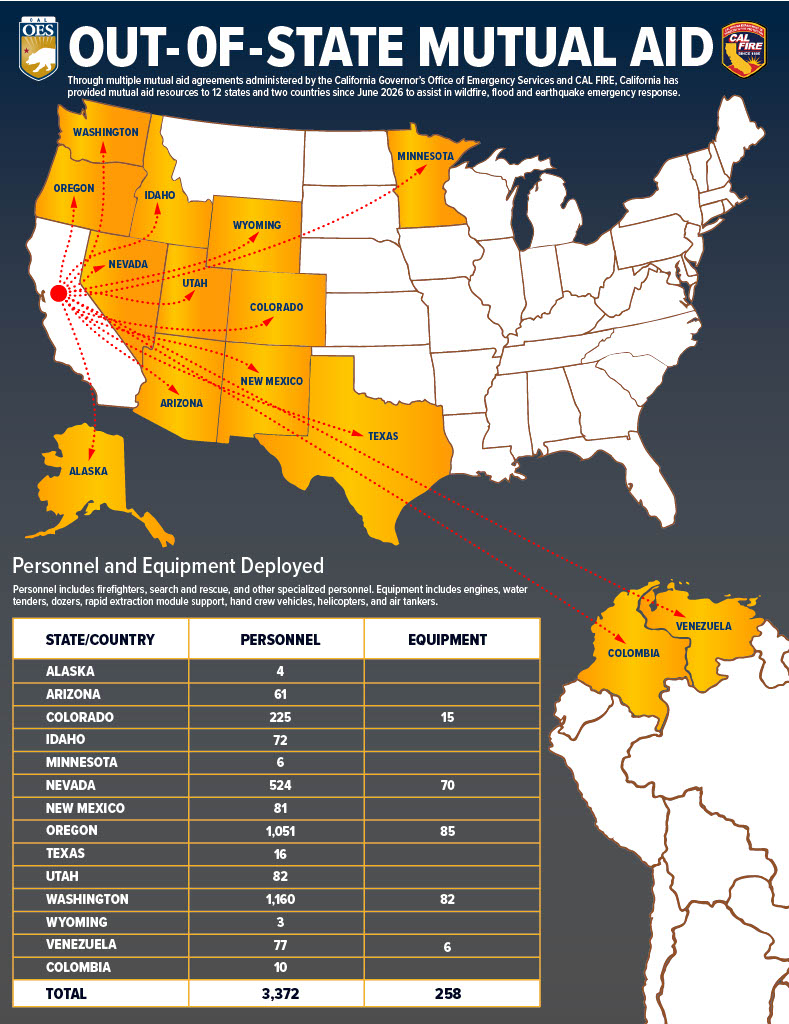
SACRAMENTO — Governor Gavin Newsom today announced that California has deployed 3,372 personnel and 258 pieces of equipment since June to support wildfire, flood, and earthquake response in 12 states and two countries, including firefighters now assisting Nevada with the Hawk Fire burning near the California-Nevada border. While California continues to support our neighbors in their time of need, these deployments have not impacted the state’s ability to respond to emergencies and protect communities at home.
“In moments of disaster, the distance between us matters less than the duty we share.
As disasters impact our neighbors across the West, California’s first responders are bringing their experience, courage and care to communities in need, while remaining
ready to protect the people they serve at home.”
Governor Gavin Newsom
That capacity exists because Governor Newsom and the Legislature have made unprecedented investments in wildfire and emergency response, nearly doubling funding over the past several years.
By the numbers: California always answers the call
As climate‑driven fires grow more frequent and severe, California continues to move forward with its own investments and mutual aid commitments, even as federal disaster leadership and long‑term recovery support have not kept pace with the scale of the crisis.
This summer, California has supported states across the western United States and beyond as they face their own extreme weather events.
These deployments have included on‑the‑ground firefighting, urban search and rescue, and recovery planning. All while ensuring coverage for communities here at home. California has supported the following states and countries since June 2026:
- 12 states: Alaska, Arizona, Colorado, Idaho, Minnesota, Nevada, New Mexico, Oregon, Texas, Utah, Washington, and Wyoming
- 2 countries: Venezuela and Colombia
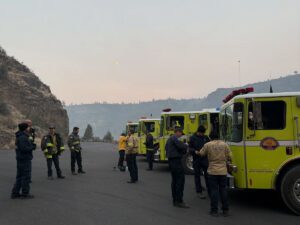 California supporting Washington’s firefighting efforts this summer
Since June 1, the California Governor’s Office of Emergency Services (Cal OES) has coordinated and mobilized local government fire agencies through interstate mutual aid deployments to 12 states. Through the California Fire and Rescue Mutual Aid System, approximately 200 local government fire agencies have answered the call, deploying 2,921 firefighters, 172 fire engines, specialized equipment, and other resources. Protecting communities threatened by wildfires and other hazards.
This commitment is on display today in Nevada, where California resources are supporting response operations to the Hawk Fire near Reno. In all, 28 California local government fire agencies have sent 130 personnel and 31 fire apparatus to Nevada, joining a large, multi-state response working to protect lives and communities threatened by the fire.
CAL FIRE has directly supported 12 wildfires across Oregon, Washington, Nevada, Colorado, and Texas, with nearly 600 CAL FIRE personnel deployed out-of-state since July 1, representing thousands of hours of sustained work on the ground. Of the 12 wildfires supported, 10 occurred in areas managed by the federal government, demonstrating California’s role in supporting both neighboring states and the federal wildfire response.
CAL FIRE resources supported wildfire incidents under state and federal jurisdictions, including:
- Oregon Department of Forestry
- Washington Department of Natural Resources
- U.S. Forest Service
- Bureau of Land Management
California also responded to 37 incidents managed by federal incident management teams.
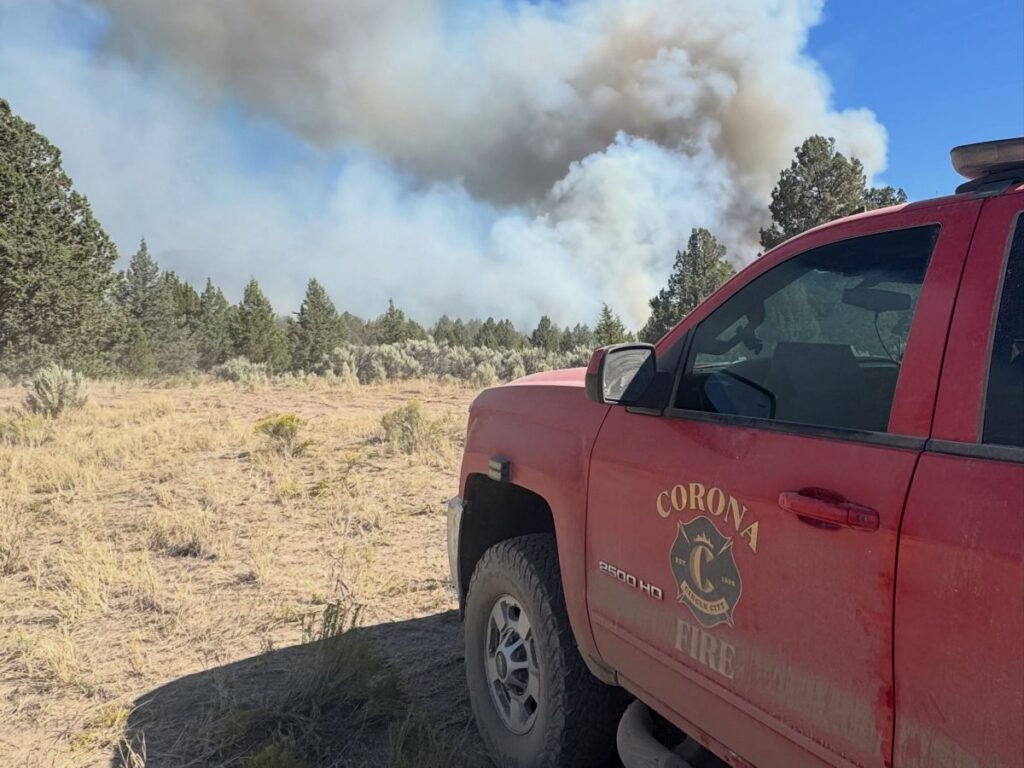 California supporting firefighting efforts following Oregon’s Grasshopper Fire
Leading the world in emergency management innovations
As Governor Newsom highlighted last month, California continues investing in the tools that actually save lives and homes. Here’s what that looks like in practice:
-
Expanding the world’s largest aerial firefighting fleet: California became the first state in the nation to own, operate, and deploy C-130H airtankers for wildfire suppression — and the fleet keeps growing. The state now operates four, with a planned fleet of seven underway. These large-capacity aircraft deliver significant volumes of fire retardant in a single mission and will be stationed at CAL FIRE bases statewide, ready to mobilize alongside the state’s helicopters, other aircraft, and firefighters.
-
Early detection: CAL FIRE has collaborated with the Earth Fire Alliance on early adoption of wildfire detection satellites. The first three FireSat wildfire detection satellites launched this past July from Vandenberg Space Force Base to give firefighters faster, more precise intelligence to spot fires earlier and protect communities.
-
Eyes on the fire: UC San Diego and the State of California partnered to develop ALERTCalifornia, a statewide network of over a thousand cameras to identify and monitor wildfires. ALERTCalifornia AI-Cameras have detected over 900 fires on state lands before 911 calls were made, and were named one of TIME’s Best Inventions of 2023.
-
Real-time intel: The first-in-the-nation Fire Integrated Real-Time Intelligence System (FIRIS), managed by Cal OES, provides real-time aerial intelligence, advanced fire mapping, and predictive analytics to support wildfire response for every California County. Flying over 2,000 missions since the start of the program in 2019, FIRIS, along with CAL FIRE’s aerial intelligence platform, Intel 641, are critical assets to help identify real-time fire mapping within minutes of ignition.
-
Forecasting the threat: California’s Wildfire Forecast & Threat Intelligence Integration Center (WFTIIC) is a first-of-its-kind center serving as the state’s central hub for coordinating wildfire forecasting, weather intelligence, and fire threat assessments.
-
Mapping wildfire risk: Last year, California launched LiDAR (Light Detection and Ranging) three-dimensional maps of the entire state. LiDAR maps are the gold standard for finding forest and vegetation information, helping decision-makers get a clear picture of fuel loads and wildfire risks.
-
World’s first redwood forest observatory: California installed the first redwood forest observatory — two research towers in Jackson Demonstration State Forest that measure the inflow and outflow of carbon dioxide, water vapor, and energy between redwoods and their environment. The flux towers provide real-time insight into how redwoods respond to changing environmental conditions, wildfire, and management. Within the next year, aggregated measurements will be processed for public use.
-
Harnessing AI: California is testing and researching new and innovative technologies to bolster firefighting and preventative operations. The use of AI-guided wildfire suppression drones will be beneficial in low-visibility conditions by providing extended aerial response capabilities when crewed aircraft cannot operate. The state is researching the use of AI-guided drones to improve extended supply deliveries during field and fire operations, thereby eliminating current modes of human or aircraft delivery in difficult and dangerous scenarios.
-
New strike team strengthens Los Angeles response: Cal OES assigned five new Type-6 fire engines to the Los Angeles City Fire Department, forming a strike team that can respond quickly in both urban and wildland areas. Type-6 engines are the smallest, most maneuverable units in the state fleet — typically four-wheel drive, carrying 300 gallons of water, and designed to reach steep, narrow, or remote locations. The engines are state-owned and prepositioned with the Los Angeles Fire Department through California’s Fire and Rescue Mutual Aid System. This means they can respond immediately to local incidents and deploy to other regions when mutual aid is requested. Cal OES manages a fleet of more than 270 state-owned fire engines assigned to over 60 local agencies statewide, ensuring every community can access coordinated emergency resources when disasters strike. Since 2019, Governor Newsom and the Legislature have invested in expanding and replacing these mutual aid engines to sustain all-hazards readiness across California.
California’s unprecedented wildfire readiness
As part of the state’s ongoing investment in wildfire resilience and emergency response, CAL FIRE has significantly expanded its workforce over the past five years by adding an average of 1,800 full-time and 600 seasonal positions annually — nearly double that of the previous administration. Over the next four years and beyond, CAL FIRE will be hiring thousands of additional firefighters, natural resource professionals, and support personnel to meet the state’s growing demands.
This builds on consecutive years of intensive and focused work by California to confront the severe ongoing risk of catastrophic wildfires. New, bold moves to streamline state-level regulatory processes build long-term efforts already underway in California to increase wildfire response and forest management in the face of a hotter, drier climate.
As the conditions that fueled 2020 become more common, Cal OES and CAL FIRE urge residents to prepare:
- Sign up for local emergency alerts to keep you and your loved ones informed at ready.ca.gov/alerts. When you sign up, you can choose how to receive alerts, including cell phone, home phone, email, and text.
- Visit the CAL FIRE Incident Map for real-time information on current incidents across the state.
- Check out Readyforwildfire.org for wildfire preparedness tips like creating a wildfire action plan, how to create a defensible space, and expert advice to stay one step ahead of wildfires.
- Visit Listos California for emergency preparedness resources in more than 15 languages, including indigenous Mexican languages. Tools available on Listos California can help you and your family prepare for several types of emergencies, including wildfires and wildfire smoke.
The cost of Trump’s neglect
Donald Trump and the Republican-led Congress have cut more than 5,800 jobs from the U.S. Forest Service (USFS), the same agency that manages 193 million acres of federal public lands across 154 national forests, and officials are sounding the alarm about a 15% drop in elite firefighting crews that are trained to fight some of the most challenging, hard-to-reach blazes. At the same time, Trump is slashing critical science-backed programs at U.S. EPA and USFS labs that help keep firefighters and communities safe, proposing to close 57 of the 77 research labs nationwide, including facilities that track wildfire smoke and study where controlled burns can reduce fire risk. To make matters worse, the Trump administration treated nearly 1.5 million fewer acres for wildfire prevention last year, including a nearly 50% drop in prescribed burns. That left more hazardous, fire-prone vegetation untreated, increasing the risk of hotter, faster-moving and potentially more catastrophic wildfires.
To deflect from his own wildfire failures and make excuses for his weak leadership, Trump threatened to impose tariffs on Canada over wildfire smoke that blanketed the East Coast.
With fewer teams able to handle these massive fires at the federal level, California is answering the call by coordinating the deployment of personnel and resources alongside local and state partners.
California’s mutual aid leadership
California has a long history of answering the call when communities face their greatest challenges. Through its nationally recognized mutual aid system, California has deployed highly trained, expert personnel and specialized resources to disasters across the country and around the world.
California teams have responded to disasters in Florida, Washington, Alaska, Texas, New Mexico, Montana, Wisconsin, Hawaii, Jamaica, Arizona, and Puerto Rico. Hurricanes Harvey, Irma, and Maria, and Hurricane Ian are among other events California has supported.
###